Describe interactive systems.
"users” perception of seeing opportunities to create their own human to human interactions with personal media.
Some missing components
The list of interactive systems contains many components and the question is whether something is missing. I would first say, that "purpose", it's important to talk about the purpose while actors are using interactive system and ask why they are doing this. For me one related thing with purpose is that tasks have to be "understandable". Actors have to relate tasks with the purpose of what they are doing and where is the way going to - even if the purpose is not explained detailly, every step/task has to answer some questions and get actors closer to their purpose - even if the purpose actually changes on the way.
As it's important to measure the quality of participants tasks, it's also important to explain the exact "requirements" that is closely connected with the overall rules of the interactive system.
Irrelevant components?
I would say that it's hard to define what would be irrelevant, the idea and theory behind this list came from somewhere, and all the components where listed to fill the whole system. And it depends on where do I look from.
I would take "location" as one irrelevant component or replace it with "internet" as the location is not important in geographical point of view, but the requirements that the location gives are - it has to have internet connection and a computer that allows to use software that is necessary.
For my better understanding I made a mindmap of the list and tried to define what bigger groups I could make form the components that were originally listed. And I grouped it this way:
Purpose - Methodology - Participants - Time - Tools - Interrelatedness.
In a little longer sentence it would be translated as:
Firs tit's important to define the overall purpose of the interactive system and define the methodology used for it, before we can connect methodology and time we have to know who are the participants and what access to what tools they might have. Interrelatedness does connect different participants and also defines their roles that is already subcomponent in these groups.
Activity theory and the list of components
I starte this post with idea to add "purpose" as one of the components to the list in question. And I feel that if the purpose would be listed it would be much better to explain it also through activity theory, then we could know who or what I should list as subjects or objects.
From the list I can understand that "rules" are definitely the part that are well thought through and can be listed to activity theory, as project manager was also listed, I would assume that I can also list the division o labour, and the community behind it and main activities.
As activity theory is pretty dynamic it basically allows to fit any list into the theory - it just depends on who we list as subject and how we write down the object and outcome from that. It's like learning to ask same question in different ways and fitting it into the theory and we get the explanation that was needed.
Showing posts with label IFI7144. Show all posts
Showing posts with label IFI7144. Show all posts
Sunday, December 5, 2010


Sunday, November 28, 2010
Task 10 NIE - Activity theory in real
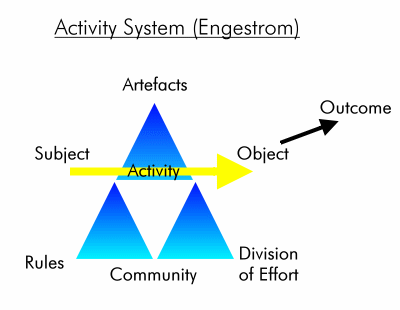 Visualizing the activity theory is the best way to draw similar views for 2 courses to compare them. I take Engestrom triangle as the source for my analysis, and build New Interactive Environment course and PLENK on this one.
PLENK2010
 |
| PLENK2010 visualization according Activity theory |
Subjects: Participants
Object: According the homepage of PLENK2010 The purpose of this course will be to clarify and substantiate, from the context of this new research, the concepts of personal learning environments and networks. Course facilitators and participants will analyze the research literature and evaluate it against their own experience with the intent of developing a comprehensive understanding of personal learning environments and networks.
Rules: Signing up, course activities, privacy policy
Instruments: live sessions, course content, wiki, personal learning environment, daily newsletter, RSS feed, SM tools - Twitter, blogs, Moodle, Delicious, other possible SM tools according the flow and need in the course.
Community: guest speakers, students, teachers,
Effort: students,
New interactive environments
 |
| New Interactive Environments visualized according Activity theory |
Subjects are students who participate in this course.
Object is the curriculum of New Interactive Environment. It says: Participants acquire conceptual knowledge and procedural skills on how to analyse, represent, and (re-)instrumentalise human activities and activity systems with networked tools and services.
Rules are the tasks, and deadlines that are listed by the teachers. But also the means how to fill the tasks are aprt of rules here - for example that tasks has to be done for certain deadline by certain ways - in blogs.
Instruments (artefacts) - there are several instrumenrs used in this course. Several are software tools that students use to do their homework and fill tasks - both online and offline tools. One of the most important instrument is the blog where students show their tasks and the course blog where new tasks are being published.
NIE wiki
NIE wiki
Community in this NIE course can be taken as small group of people who participate in this course, but I would also consider it in a broader way, as community that affects the learned subject is much bigger. I would also take the whole IMKE department and Tallinn University in this community. As tasks are published through blogs then anonymous blogosphere is also part of the community in here.
Effort - students are the ones who fill the tasks in here. But we should't forget teachers who come up with tasks as well. Students couldn't do their tasks if someone wouldn't list them.
Comparison of NIE and PLENK2010 courses according Activity theory
Both of the courses are online courses, it makes them quite similar from Activity theory perspective as well.
Both courses use several social media and digital media tools as part of the course and tasks are being shown by menas of these tools. Students are subjects and community in both courses and teachers are the ones who give tasks
Both courses are also similar by overall way of course building, not all tasks or deadlines are given before the course, but considering the flow and ways how course goes new tasks and deadlines are given.
Comparison of NIE and PLENK2010 courses according Activity theory
Both of the courses are online courses, it makes them quite similar from Activity theory perspective as well.
Both courses use several social media and digital media tools as part of the course and tasks are being shown by menas of these tools. Students are subjects and community in both courses and teachers are the ones who give tasks
Both courses are also similar by overall way of course building, not all tasks or deadlines are given before the course, but considering the flow and ways how course goes new tasks and deadlines are given.
As I understand the students in PLENK2010 course are not necessarily students from thabasca University and the University of Prince Edward Island but can be anyone who are interested, this is the main difference with NIE as students in NIE are Tallinn University students who chose to take the course and get graded for what they do in NIE.
In PLENK2010 there are also guest lecturers and everybody are expected to listen to them.
Also tools like Twitter and blogsa re expected to be used not only to fill the tasks, but to talk about the thoughts that participatns come up with and tag them with #PLENK2010
Students/participants are important in both courses, they are subjects, they are the ones who use all the tools, they are the ones who are "labor" for the course, and at the same time influence the course overall doings through communication and thoughts.
Students/participants are important in both courses, they are subjects, they are the ones who use all the tools, they are the ones who are "labor" for the course, and at the same time influence the course overall doings through communication and thoughts.
Thursday, November 18, 2010
Task 9 NIE - Activity theory
I will try to explain what Activity theory is for me. I could list some definitions from researchers, psychologists or AI analysts, but I think it would be much more useful to try to explain it in my own words, after I have read several articles and used Google search to find out more where and how Activity theory is used.
Historically activity theory started in the beginning of 20th century in Russia. Today one of the most important activity theory centers is in Helsinki. A lot of different researches come from there. Most of them are from IT fields, where human action and computer (mediated) actions are analysed.
While Pavlov explained a lot of animal behavior through instincts, then it couldn't explain everything. Võgotsky and Leontjev took pavlov's instincts based theory further and it started activity theory. The idea is, animals and people do things because we plan and know we need or have to to get something else - for example fulfill our needs. When we talk about only humans then activity theory is based on knowingly doing things, taking and handling the reality, which has also been called activity.
In psychology Activity theory is important in learning theories. This is what it's taken to IT fields as well - it's important to understand how people learn, to be able to make some AI learn from it's activities. By activity theory learning is done through the actions that form a system and make sensible organizational base. Later we can use learned things to decide what to do, or act in a certain way. Activity theory is continuos, everything can change based on new experience and actions that are done.
* this overview is written based on different articles, wikipedia and definitions.
 |
| Reaching the goal by Activity theory. Leontjev |
While Pavlov explained a lot of animal behavior through instincts, then it couldn't explain everything. Võgotsky and Leontjev took pavlov's instincts based theory further and it started activity theory. The idea is, animals and people do things because we plan and know we need or have to to get something else - for example fulfill our needs. When we talk about only humans then activity theory is based on knowingly doing things, taking and handling the reality, which has also been called activity.
In psychology Activity theory is important in learning theories. This is what it's taken to IT fields as well - it's important to understand how people learn, to be able to make some AI learn from it's activities. By activity theory learning is done through the actions that form a system and make sensible organizational base. Later we can use learned things to decide what to do, or act in a certain way. Activity theory is continuos, everything can change based on new experience and actions that are done.
* this overview is written based on different articles, wikipedia and definitions.
Sunday, November 14, 2010
Task 8 - from personal media to influencing masses
For long media channels have filtered news and information for audience, so that audience gets what the media channel decides is important to share and forward. As now one person can influence and have audience by himself, professional media channels are challenged to know more and explain why some news are shared and others are not. At the same time these media channels get quick feedback that either praises them for shared information or blames for leaving something behind.
 Before the communication was one-sided, people got what they wanted. This week I heard a American talking about his high school time in the beginning of 80's when they also had only 3 TV channels to choose from compared to hundreds they have now. All these TV channels have to compete of having bigger audiences. And if during 80's a channel could easily have 80 million people watching a show, then today it's already good if they have 1 million, the drop has been enormous. At the same time, all these channels get feedback from their audience and have to rely on it. Even more and more they are using real-live shows. It's cheap, but from the other side its direct communication of the audience. The audience is who decides what is going to happen and participants are among the same audience.
This we already know that privately held blogs might grow even bigger than official media channels or newspapers online versions. These people who manage their personal blogs usually are not professional journalists. They just care about a topic so much that they want to talk about it, and if there is enough readers, who read it and share it, comment blog posts and it's searchable through search engines - it will get into masses.
Lüders wrote in his article "Internet works within all of society's social systems, increasing levels of self-reflection." There is nothing new in her statement. Internet is generally cheap, it can be used with cheaper technical tools and it's accessible by most society classes.
For me talking about the possibilities that Internet provides usually seems even totally common thing. So it has changed the way we communicate or perceive information. Mass media is not the the same mass media we knew 20 years ago. I am more interested in how people use these new ways they have and if and how it has changed a person or groups? I think people more and more understand how much influence they might have. There has always been the desire to influence, but now people have the tools they didn't have before. We already have some really good examples of how Internet has helped to start non-violent revolution (through Facebook in Latin-America). It wasn't done deliberately, but it happened, because so many people with same thoughts saw the outcall and new they were not alone with their thoughts and it gave them safety feeling.
So I am thinking what more is there to come, how much individuals knowlingly use the mediums and tools they now have?
Sunday, November 7, 2010
Task 7 - interactivity, from my point of view
Interactive webpage
When I talk about interactive webpage, then I mean a webpage where user can contribute for example in writing something that other users can read and give their opinions or thoughts on. Simplest is probably an internet forum where somene can start a thread and others will continue to discuss about the topic they are interested and have information on.
But often a question is asked “how to make a website more interactive?”.
Then people don’t really mean only technical possibilities but also the overall feeling - usability and accessibility are also part of discussion now.
For me interaction is basically communication where all parties can give their input. Therefore TV series aren’t but for example TV shows where watchers can vote for singers they like the most, already is.
Interactive for all
The two articles we read for Task 5 and Task 6 made me think that interactivity is not the same concept for all the people but it depends on the research field for example and from one's perspective and feeling.
I am interested in groups - from the research field side. I like to think how roups are formed online for example, if the same human groups and “interaction” can give a person what is comparable from a reallife experience. IN these group discussions interaction an communication is also important. And from here I could try to define what interaction is for me and how it differs from communication.
Inter should mean between someone and action, doing something. Putting these things together means that there are different sides who are doing something that influences both sides. Communication is probably part of interaction, althought it might ssometimes seem like a broader term. While communication is for example the email that we send to a friend, then interaction is “sending email, reading the email, thinking of replying to it or not replying”. All this is interaction it contains different parts and all details are important. Having a discussion about dogs is communication but also interaction, the overall bubble around saying words, looking in the eyes, being ready for answering and being influenced by the other side for wanting, needing or being told to participate.
Dance interactive
While I was looking for information, some interesting articles or pages that would talk about interactivity I came across Dance Interactive. It's a page that selles 6 different videos for teaching the exact movement of dance motions.
The reason why I found it was I started to think how much dancing is interactive. Of course it is! It's built on communication, feeling, answering actions and getting the "touch" that makes to want to continue.
Technical tools help to give dancing videos something different, so that it's not only about people who dance, but the show itself is based on the movement of actor.
WII game is one of the best examples of interactiv dancing with technical support.
Interactivity is subjective term. There is no correct answer that would fit for everyone.
Sunday, October 31, 2010
Task 6 - More about "Interactivity"
This post is based on the article "Interactivity: a concept explication" by Spiro Kiousis.
In overall Kiousis seems to have taken investigation fo interactivity really seriously. I liked his way of Although it might also be affected by his abstract where he says that in his view interactivity has both media and psychological factor.
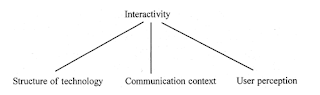 Like a correct metaanalysis, Kiousis gives an overview of previous articles and definitions about interactivity. He also uses several thoughts and theory from Jensens article that we read for task 5. His way of working and analysis is really interesting, for later understanding he explains visually and puts together 3 dimensions: technology, communication and user perception. Later in the article he builds his theory on the same graphic.
Kousis finds it important to consider both computer mediated and non-computer mediated communication. It seems to him that several researchers consider too much on technological tools that are used for communication and that help to fill the criteria that they have set for "interactivity".
In article conclusion it's said that interactivity could be defined as the degree to which a communication technology can create a mediated environment in which participants can communicate (one-to-one, one-to-many, and many- to-many) both synchronously and asynchronously and participate in reciprocal message exchanges (third-order dependency).
 I find it interesting that Kiousis also explains user perception because it's really subjective and not easy to measure. But I agree it's important and while the article started with searching the definition mostly form psychological and media point of view those who actually take part in action are important.
As the graphical picture above already gives all the important terms of Kiousis definition, I will not start to name them once more.
Like said above, Kiuosis tries to build together one stronger theory that would fit several previous definitions under it. For me it seems a logical way, often researchers look at the things too narrowly and a metaanalysis helps to take most important details and sew them together into a big picture.
References:
Kiousis, S. (2002) "Interactivity: a concept explication", New Media & Society, 4(3): 355–383.
In overall Kiousis seems to have taken investigation fo interactivity really seriously. I liked his way of Although it might also be affected by his abstract where he says that in his view interactivity has both media and psychological factor.
 Like a correct metaanalysis, Kiousis gives an overview of previous articles and definitions about interactivity. He also uses several thoughts and theory from Jensens article that we read for task 5. His way of working and analysis is really interesting, for later understanding he explains visually and puts together 3 dimensions: technology, communication and user perception. Later in the article he builds his theory on the same graphic.
Kousis finds it important to consider both computer mediated and non-computer mediated communication. It seems to him that several researchers consider too much on technological tools that are used for communication and that help to fill the criteria that they have set for "interactivity".
In article conclusion it's said that interactivity could be defined as the degree to which a communication technology can create a mediated environment in which participants can communicate (one-to-one, one-to-many, and many- to-many) both synchronously and asynchronously and participate in reciprocal message exchanges (third-order dependency).

As the graphical picture above already gives all the important terms of Kiousis definition, I will not start to name them once more.
Like said above, Kiuosis tries to build together one stronger theory that would fit several previous definitions under it. For me it seems a logical way, often researchers look at the things too narrowly and a metaanalysis helps to take most important details and sew them together into a big picture.
References:
Kiousis, S. (2002) "Interactivity: a concept explication", New Media & Society, 4(3): 355–383.
Saturday, October 30, 2010
Task 5 - Interactivity, finding the true definition?!
This post is based on the article "‘Interactivity’ Tracking a New Concept in Media and Communication Studies" by Jens F. Jensen.
Jensen's article is long explaining article, giving an overview of the background of "Interactivity" definitions. I am always a critical person, so I ask - why he wrote that he will also give a new possibility to define the term - when all he did for me seems like he put the different theories together. And he has now a lot more information than those researchers he citates. But as he didn't still use any social network examples I started to think when was the article written - 1998 it seems. It's more than 10 years ago!
Like he says "Interactivity" comes from the word "Interaction" which means different things depending on what is one's background in scientific field. It was the most important thing for me in this article - I started to truly think how I take the word and term "interaction" really self-explanatory, and have never thought about how physics or neuroscientists see it, or if they even use it.
The 3-dimensional model that Jensen gives at the end fits well in the world we know today. I would also say that other researchers who had their theories also thought them really well depending on the information they had, especially Heeter in 1989, this really surprised me. Although in her table she also used media tools, she also explained the change of interaction and communication channels that will change. And there wasn't even Internet yet!
Jensen takes into consideration 3 different variables that help to understand the depth of interaction and interactivity
Before I haven't read some newer versions of scientifically trying to prove the meaning or theory of "interactivity" the one Jensen gives with his conclusion, seems to be working one.
The picture on the right is a toy for baby's. It's name is "Interactivity cube". I think it shows really well, how different sides influence each other and are connected. And I know that children growing up today, will have the touch of it much more than we did on 80's. With different tools (I mena internet tools, tv tools, all kinds of technological wonders) we, the people, will be able to find more and more needs that we didn't know we even had.
Jensen's article is long explaining article, giving an overview of the background of "Interactivity" definitions. I am always a critical person, so I ask - why he wrote that he will also give a new possibility to define the term - when all he did for me seems like he put the different theories together. And he has now a lot more information than those researchers he citates. But as he didn't still use any social network examples I started to think when was the article written - 1998 it seems. It's more than 10 years ago!
Like he says "Interactivity" comes from the word "Interaction" which means different things depending on what is one's background in scientific field. It was the most important thing for me in this article - I started to truly think how I take the word and term "interaction" really self-explanatory, and have never thought about how physics or neuroscientists see it, or if they even use it.
The 3-dimensional model that Jensen gives at the end fits well in the world we know today. I would also say that other researchers who had their theories also thought them really well depending on the information they had, especially Heeter in 1989, this really surprised me. Although in her table she also used media tools, she also explained the change of interaction and communication channels that will change. And there wasn't even Internet yet!
Jensen takes into consideration 3 different variables that help to understand the depth of interaction and interactivity
- Conversational interactivity
- Registrational interactivity
- Selective interactivity
 |
| Interactivity cube - not Jensen's but the one meant for children to play and understand the meaning of different sides connecting and influencing others. |
The picture on the right is a toy for baby's. It's name is "Interactivity cube". I think it shows really well, how different sides influence each other and are connected. And I know that children growing up today, will have the touch of it much more than we did on 80's. With different tools (I mena internet tools, tv tools, all kinds of technological wonders) we, the people, will be able to find more and more needs that we didn't know we even had.
Thursday, October 14, 2010
Task3 NIE - comparison of study plans
Last week I wrote how I made plans for my semester and chose the subjects to register in. This week I took a look on other students ways to plan their semester.
I chose some of the students I personally know and some randomly, so that I could hopefully see different things.
Jakob
Valeria
Maarja
Ottavio
Maris S
All of their schedules and especially descriptions of making their study plans are really different. Starting from Jakob, who has designed a really cool and enjoyable visual overview of his studyplan and how different elements were drawn from each other.
Two students (Maarja and Maris) have said that they needed to plan their studies in Estonia while actually being abroad most of the semester, this gives them different perspective of choosing the subjects and preferring online courses to those that have seminars for example every week and it would be compulsory to take part of them.
Maris seems to be different from the others also because she is not studying IMKE and she just needed to take 2 courses, but needed online ones so she could be in Prague while taking them. This certainly narrowed her choice making.
In overall I think that as we have all been studying in different universities, at least for 3 years now (I guess some of the first course IMKE master students might suit in this) it's not so much planning or problematic to register and plan the semester.
It would be nice if all of us would be really structurized and have strong plans of their subjects and views of what they want. But it's reality that most of the students first choose the subjects they really want and then also concentrate on the curriculum to make sure that they would fulfill all the requirements.
While writing Task 2 I started to think that would it be actually useful to teach students on how to plan their semester. Yes, we are all grown-ups and should know how to handle our duties, but what if there are really easy and creative ways to be able to handle all the school things and also remember homework. But many students form IMKE also have to consider often work duties that might come first eve if their interests would prefer some IMKE courses.
Google seems to be the tool center that everybody use. It's no surprise, as it allows to have many needed things in the same place (although the power that Google has is enormous - but this is already different subject :P).
Conclusion
My main critic looking at these plans, is that they are all made after all the registering and semester planning has been done. I am sure that most of the students started to think now how they would have handed better their semester study plans while actually doing it.
I really liked two visuals from Jakob and Valeria, they really do say much more than words. But at the same time Maarja has written really detailed overview, that could probably taken as an example how a student should handle his studies.
Valeria
Maarja
Ottavio
Maris S
All of their schedules and especially descriptions of making their study plans are really different. Starting from Jakob, who has designed a really cool and enjoyable visual overview of his studyplan and how different elements were drawn from each other.
Two students (Maarja and Maris) have said that they needed to plan their studies in Estonia while actually being abroad most of the semester, this gives them different perspective of choosing the subjects and preferring online courses to those that have seminars for example every week and it would be compulsory to take part of them.
Maris seems to be different from the others also because she is not studying IMKE and she just needed to take 2 courses, but needed online ones so she could be in Prague while taking them. This certainly narrowed her choice making.
In overall I think that as we have all been studying in different universities, at least for 3 years now (I guess some of the first course IMKE master students might suit in this) it's not so much planning or problematic to register and plan the semester.
It would be nice if all of us would be really structurized and have strong plans of their subjects and views of what they want. But it's reality that most of the students first choose the subjects they really want and then also concentrate on the curriculum to make sure that they would fulfill all the requirements.
While writing Task 2 I started to think that would it be actually useful to teach students on how to plan their semester. Yes, we are all grown-ups and should know how to handle our duties, but what if there are really easy and creative ways to be able to handle all the school things and also remember homework. But many students form IMKE also have to consider often work duties that might come first eve if their interests would prefer some IMKE courses.
Google seems to be the tool center that everybody use. It's no surprise, as it allows to have many needed things in the same place (although the power that Google has is enormous - but this is already different subject :P).
Conclusion
My main critic looking at these plans, is that they are all made after all the registering and semester planning has been done. I am sure that most of the students started to think now how they would have handed better their semester study plans while actually doing it.
I really liked two visuals from Jakob and Valeria, they really do say much more than words. But at the same time Maarja has written really detailed overview, that could probably taken as an example how a student should handle his studies.
Saturday, October 9, 2010
Task 2 NIE - How I should schedule my semester
This is my third year doing IMKE which means that I have to concentrate on getting the necessary amount of credit points – but also covering all needed modules in certain amount.
I had to consider what courses are availabe and complementary for me depending on IMKE 2008 curriculum.
Because last 3 years I have been working for a company in a position where it was really hard to do real timescheduling – many quick things came in several times a day and it was my responsibility to cover them. I am not really good at timescheduling anymore. I do those things that are burning already, and at the last minute.
Overall I use different tools to remember things I have to do.
Google tools – Google Calendar (it's good that IMKE schedule is also in Google calendar now, that allowed to copy it to my own calendar). All together I have 5 different calendars – personal, IMKE, work, team, to-do. I have managed to come up with my own system how to keep track of them.
With several calendars I use reminders with SMS and Email. For example with IMKE and personal calendar.
Google Bookmarks. I have also used other bookmarking tools before. Althought with most of them synchronizing can be done easily, I have still lost important bookmarks when changing computers. And I have had to do it several times this year for example. Therefore I planned now in September to keep at least all IMKE related bookmarks in Google Bookmarks.
Google mail. As I use Google calendar and some reminders, then Google mail is the central place that brings everything together.
As a phone I use Iphone and also it's calendar tht has been syncronized with iCal that again has been syncronized with Google calendar as well.
At the same time I am also kind of old-school and sometimes I need to see things in real, with handwritten in my real bookcalendar. I also tend to remember things much better that I write down with my hand. Otherwise I tend to forget tasks or even forget to check onine what tasks I needed to do – and doing those that I do remember currently.
I created a mindmap of how I scheduled my things for this semester. I have to be honest to say that I am taking week by week and know the basic things I have to manage every month, to be able to get as many needed subjects as possible.
 |
Subscribe to:
Posts (Atom)