This post is written for Generative Content Creation based on chapter 10 from A Companion to Digital Humanities written by Rockwell and Mactavich and inteactive website "Multimedia From Wagner to Virtual Reality"
With multimedia one thing is sure - it doesn't have a short correct one definition. There are many details "multimedia" has to have, but there are too many and different ones can be shown in different multimedia tools. For example multimedia games can be free but also cost a lot and demand latest technological tools to be playable. Multimedia art can have human as part of its' interaction to be able to show its' interactivity and use different media channels.
Rockwell and Mactavich take multimedia as their main research field, they try to define what it is. They use different previous theories and figure out what is missing from these theories. They propose their own one but leave doors open to further investigation based on development of new technology.
For Rockwell and Mactavich it's important to look at the history of media to see when and where "multimedia" made its first steps. Manovich in his book "The Language fo New Media" doesn't directly investigate what multimedia is, but from his interpretation it seems he takes also early movies as part of direct multimedia. On the other hand Mactavich and Rockwell don't agree with it. For them taking pictures and mixing them together into moving pictures - movie, is not enough to have multimedia.
Developing multimedia uses "interaction" a lot, but it's also important to understand and define what is interaction and interactivity. We probably all agree it's needed to have some level of participation from human while human-computer interaction is happening - but how much? And is one sided from human- to computer interaction enough or should there come back communication form the computer as well.
Rockwell and Mactavich have built up their article logically and in a simple way to convince reader and guide the reader through the path of logical conclusion for multimedia. Their article together with Multimedia from Wagner to Virtual Reality gives a truthful historical overview of multimedia. The webpage with it's pictures and links gives access to further information and understanding. Its part of multimedia itself.
Multimedia article by Rockwell and Mactavich is written in 2004, as it's 2010 currently I would say that 6 years is a long time in this field where technology is part of theory. When Rocwell and Mactavich talk about types of multimedia, the list would be longer today including education, advertisement, entertainment or even engineering (Wikipedia). It shows how different media is more common in different fields so that we can talk about multimedia in there.
In the end of the article Rockwell and Mactavich ask what are the Academic issues we could research about Multimedia. They propose Best Practices in Multimedia production, Game criticism and Interactivity, Theories and histories of Multimedia. I would also add an important concept - how multimedia with its' interaction changes the perception of surroundings for people and how it interacts or changes the communication with other people or groups. The social network webpages that are so popular now, also carry media with itself, whether its made by the one who shares it or not - it can be video music, letter with pictures, online games and many other things. I would be interested how much it gives to a person - even if the reality feeling stays, you know what happens in virtual world and what in "real world", but you still can get real emotions out of the communication with other people or probably even computer. As multimedia is developing together with technology, and more and more communication and interaction ways are open for people it would be quite interesting to research the basic needs human have and how they are fulfilled within changing environments.
For conclusion, the articles from Mactavich and Rockwell, the interactive webpage and book by Manovich were good material to get more familiar with the concept of multimedia. Although we use the word multimedia often we don't so much think of where it comes from or what it is. Therefore it's good to take some time off and read the history and theories over it. It raises further questions, where does it go from here or what else is possible.
References:
A Companion to Digital Humanities, ed. Susan Schreibman, Ray Siemens, John Unsworth. Oxford: Blackwell, 2004. http://www.digitalhumanities.org/companion/ Chapter 10: Multimedia Geoffrey Rockwell and Andrew Mactavish
Multimedia From Wagner to Virtual Reality
The Language of New Media (1999), Lev Manovich
Multimedia, Wikipedia: http://en.wikipedia.org/wiki/Multimedia
Sunday, December 12, 2010


Task 13 NIE - redesigning activities

I was total "book-believer" before. When someone told me that it's possible to get the same feeling reading from E-reader as from rea book I said "oh yeah, right, you can believe that, but still, the smell, the page turning, the feeling of the paper". And then I held one e-reader, I have to admit, that it was totally ok - totally different form usual screen mostly closer to real book feeling and it didn't cause the pressure for the eye as screens do.
I would also enjoy more books or articles in audio format. There are many programs that can read text but it's often robotic, when a real person has taped a story it's different and you can get firsthand emotion from it.
It has become really common to sit behind computer screens and few think what it actually does to our body. When looking around on the streets we can see young people are already bent backs and problems with their eyes. While more and more activities and interactions are done with computer mediation, next important steps has to be do talk loud what it does to our bodies. I would really like to hear that some big computer companies come out with "special computer, designed to reduce your back pain". I don't know how it would actually work - there are common guidelines for offices how to use screens and what extra keyboards employees should have - but I don't see it's enough.
Thursday, December 9, 2010
Task 12 NIE - Tool or Medium

I really liked the way how Feenberg explained different theories and how he made introduction to it form historical point of view. With his logical explanations and text flow, it was quite obvious that as the last thing he will explain and persuade the reader with his critical overview. At least it happened to me.
The other article by Rückriem was really difficult to read, he does have really important points from psychology and cognition, but his way of explanations is not so well grabbed by a person who is not so much into this research field.
Feenberg compares technological development with economy - we couldn't have thought 100 years ago that economy could be run with democratic ways - but we do see it today. He thinks that same happens with technology. And I agree with him - especially from the point of view our next generations will be. They won't know the time there was no cellphone or a computer in hand immediately. But I don't think that we could say technology runs us, but we still will have means to hold control on these things.
I am also concerned of the world - where does it go, do we really need God's help like Heidegger said. We have run really far with the technological sprint - yes it's sprint when we compare it with the long history we had before, and what we have achieved and ruined within so short time through 20th century. But at the same time, it is a really short time, and we should make too strong conclusions based on only 100 years of our history. THe next generations borned in the world of technology, they will experience these things differently from us.
I would even say that the generation born after 1990 is different from the ones before - those born before can still remember the time when there wasn't cellphones, or even common landline phones at every home, so they can compare the things inside their head, they really felt it and have their own experiences. The young ones, born after 1990, they can learn the history but they don't have their own perceptions and real experiences with these things. Although I feel sorry for them and happy for myself - I can remember the time when most of the technological tools we have today weren't common and I can handle all the technological things really well, I also hope that my fear of younger generation going to waste, is not what is going to happen. But they will find their own way - all the generations always have found.
Sunday, December 5, 2010
Task 11 NIE - the list of components
Describe interactive systems.
"users” perception of seeing opportunities to create their own human to human interactions with personal media.
Some missing components
The list of interactive systems contains many components and the question is whether something is missing. I would first say, that "purpose", it's important to talk about the purpose while actors are using interactive system and ask why they are doing this. For me one related thing with purpose is that tasks have to be "understandable". Actors have to relate tasks with the purpose of what they are doing and where is the way going to - even if the purpose is not explained detailly, every step/task has to answer some questions and get actors closer to their purpose - even if the purpose actually changes on the way.
As it's important to measure the quality of participants tasks, it's also important to explain the exact "requirements" that is closely connected with the overall rules of the interactive system.
Irrelevant components?
I would say that it's hard to define what would be irrelevant, the idea and theory behind this list came from somewhere, and all the components where listed to fill the whole system. And it depends on where do I look from.
I would take "location" as one irrelevant component or replace it with "internet" as the location is not important in geographical point of view, but the requirements that the location gives are - it has to have internet connection and a computer that allows to use software that is necessary.
For my better understanding I made a mindmap of the list and tried to define what bigger groups I could make form the components that were originally listed. And I grouped it this way:
Purpose - Methodology - Participants - Time - Tools - Interrelatedness.
In a little longer sentence it would be translated as:
Firs tit's important to define the overall purpose of the interactive system and define the methodology used for it, before we can connect methodology and time we have to know who are the participants and what access to what tools they might have. Interrelatedness does connect different participants and also defines their roles that is already subcomponent in these groups.
Activity theory and the list of components
I starte this post with idea to add "purpose" as one of the components to the list in question. And I feel that if the purpose would be listed it would be much better to explain it also through activity theory, then we could know who or what I should list as subjects or objects.
From the list I can understand that "rules" are definitely the part that are well thought through and can be listed to activity theory, as project manager was also listed, I would assume that I can also list the division o labour, and the community behind it and main activities.
As activity theory is pretty dynamic it basically allows to fit any list into the theory - it just depends on who we list as subject and how we write down the object and outcome from that. It's like learning to ask same question in different ways and fitting it into the theory and we get the explanation that was needed.
"users” perception of seeing opportunities to create their own human to human interactions with personal media.
Some missing components
The list of interactive systems contains many components and the question is whether something is missing. I would first say, that "purpose", it's important to talk about the purpose while actors are using interactive system and ask why they are doing this. For me one related thing with purpose is that tasks have to be "understandable". Actors have to relate tasks with the purpose of what they are doing and where is the way going to - even if the purpose is not explained detailly, every step/task has to answer some questions and get actors closer to their purpose - even if the purpose actually changes on the way.
As it's important to measure the quality of participants tasks, it's also important to explain the exact "requirements" that is closely connected with the overall rules of the interactive system.
Irrelevant components?
I would say that it's hard to define what would be irrelevant, the idea and theory behind this list came from somewhere, and all the components where listed to fill the whole system. And it depends on where do I look from.
I would take "location" as one irrelevant component or replace it with "internet" as the location is not important in geographical point of view, but the requirements that the location gives are - it has to have internet connection and a computer that allows to use software that is necessary.
For my better understanding I made a mindmap of the list and tried to define what bigger groups I could make form the components that were originally listed. And I grouped it this way:
Purpose - Methodology - Participants - Time - Tools - Interrelatedness.
In a little longer sentence it would be translated as:
Firs tit's important to define the overall purpose of the interactive system and define the methodology used for it, before we can connect methodology and time we have to know who are the participants and what access to what tools they might have. Interrelatedness does connect different participants and also defines their roles that is already subcomponent in these groups.
Activity theory and the list of components
I starte this post with idea to add "purpose" as one of the components to the list in question. And I feel that if the purpose would be listed it would be much better to explain it also through activity theory, then we could know who or what I should list as subjects or objects.
From the list I can understand that "rules" are definitely the part that are well thought through and can be listed to activity theory, as project manager was also listed, I would assume that I can also list the division o labour, and the community behind it and main activities.
As activity theory is pretty dynamic it basically allows to fit any list into the theory - it just depends on who we list as subject and how we write down the object and outcome from that. It's like learning to ask same question in different ways and fitting it into the theory and we get the explanation that was needed.
Sunday, November 28, 2010
Task 10 NIE - Activity theory in real
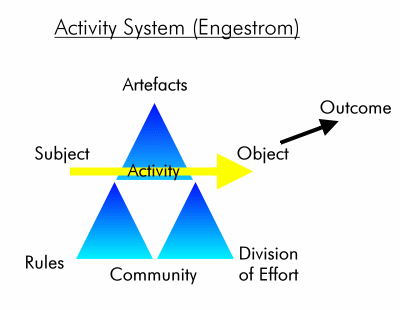 Visualizing the activity theory is the best way to draw similar views for 2 courses to compare them. I take Engestrom triangle as the source for my analysis, and build New Interactive Environment course and PLENK on this one.
PLENK2010
 |
| PLENK2010 visualization according Activity theory |
Subjects: Participants
Object: According the homepage of PLENK2010 The purpose of this course will be to clarify and substantiate, from the context of this new research, the concepts of personal learning environments and networks. Course facilitators and participants will analyze the research literature and evaluate it against their own experience with the intent of developing a comprehensive understanding of personal learning environments and networks.
Rules: Signing up, course activities, privacy policy
Instruments: live sessions, course content, wiki, personal learning environment, daily newsletter, RSS feed, SM tools - Twitter, blogs, Moodle, Delicious, other possible SM tools according the flow and need in the course.
Community: guest speakers, students, teachers,
Effort: students,
New interactive environments
 |
| New Interactive Environments visualized according Activity theory |
Subjects are students who participate in this course.
Object is the curriculum of New Interactive Environment. It says: Participants acquire conceptual knowledge and procedural skills on how to analyse, represent, and (re-)instrumentalise human activities and activity systems with networked tools and services.
Rules are the tasks, and deadlines that are listed by the teachers. But also the means how to fill the tasks are aprt of rules here - for example that tasks has to be done for certain deadline by certain ways - in blogs.
Instruments (artefacts) - there are several instrumenrs used in this course. Several are software tools that students use to do their homework and fill tasks - both online and offline tools. One of the most important instrument is the blog where students show their tasks and the course blog where new tasks are being published.
NIE wiki
NIE wiki
Community in this NIE course can be taken as small group of people who participate in this course, but I would also consider it in a broader way, as community that affects the learned subject is much bigger. I would also take the whole IMKE department and Tallinn University in this community. As tasks are published through blogs then anonymous blogosphere is also part of the community in here.
Effort - students are the ones who fill the tasks in here. But we should't forget teachers who come up with tasks as well. Students couldn't do their tasks if someone wouldn't list them.
Comparison of NIE and PLENK2010 courses according Activity theory
Both of the courses are online courses, it makes them quite similar from Activity theory perspective as well.
Both courses use several social media and digital media tools as part of the course and tasks are being shown by menas of these tools. Students are subjects and community in both courses and teachers are the ones who give tasks
Both courses are also similar by overall way of course building, not all tasks or deadlines are given before the course, but considering the flow and ways how course goes new tasks and deadlines are given.
Comparison of NIE and PLENK2010 courses according Activity theory
Both of the courses are online courses, it makes them quite similar from Activity theory perspective as well.
Both courses use several social media and digital media tools as part of the course and tasks are being shown by menas of these tools. Students are subjects and community in both courses and teachers are the ones who give tasks
Both courses are also similar by overall way of course building, not all tasks or deadlines are given before the course, but considering the flow and ways how course goes new tasks and deadlines are given.
As I understand the students in PLENK2010 course are not necessarily students from thabasca University and the University of Prince Edward Island but can be anyone who are interested, this is the main difference with NIE as students in NIE are Tallinn University students who chose to take the course and get graded for what they do in NIE.
In PLENK2010 there are also guest lecturers and everybody are expected to listen to them.
Also tools like Twitter and blogsa re expected to be used not only to fill the tasks, but to talk about the thoughts that participatns come up with and tag them with #PLENK2010
Students/participants are important in both courses, they are subjects, they are the ones who use all the tools, they are the ones who are "labor" for the course, and at the same time influence the course overall doings through communication and thoughts.
Students/participants are important in both courses, they are subjects, they are the ones who use all the tools, they are the ones who are "labor" for the course, and at the same time influence the course overall doings through communication and thoughts.
Subscribe to:
Posts (Atom)